

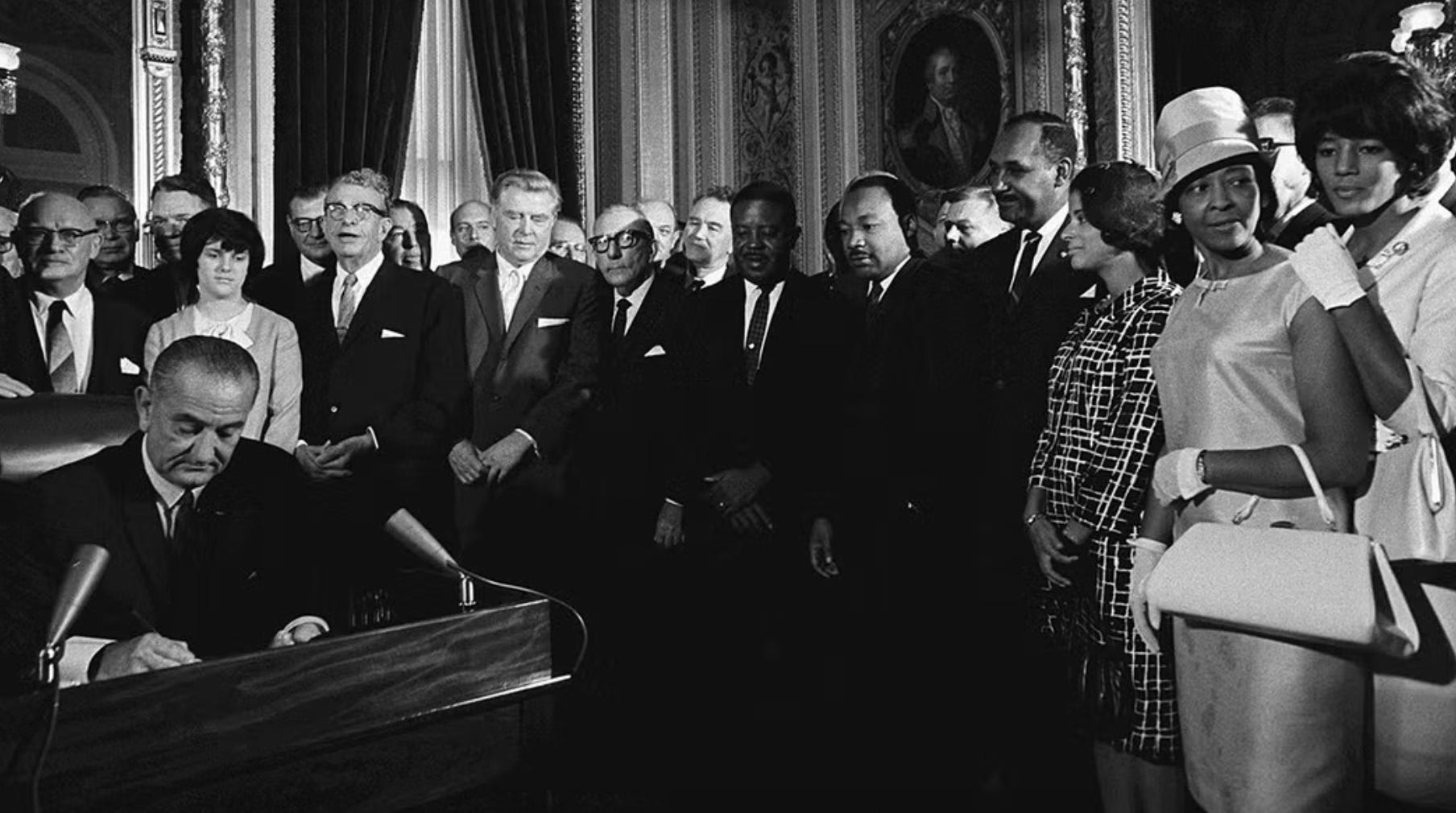
Six decades ago, the Voting Rights Act of 1965 transformed American democracy from a theoretical ideal into a functional reality.
It did not arrive as a gift. It was a hard-won victory forged in the crucible of Selma and Birmingham. It was the response to decades of poll taxes, literacy tests, and a systematic regime of terror designed to ensure the ballot box remained a private club. The law was blunt because the problem was surgical: it established federal oversight for bad actors, provided tools to challenge maps that diluted minority power, and stated — in no uncertain terms — that the right to vote was the baseline of the American contract.
For over half a century, it worked. It wasn’t perfect, and it wasn’t a cure-all, but it provided the stability our system required for freedom to grow.
Last week, the Supreme Court’s ruling in Louisiana v. Callais effectively ended that chapter. In a 6-3 decision, the Court’s majority didn’t just tweak the rules; they essentially gutted Section 2 of the VRA — the primary tool used to challenge electoral maps that discriminate. Justice Kagan, in a blistering dissent, called it a “death knell.” For anyone who believes that the integrity of the process is more important than the temporary victory of a party, she was being remarkably literal.
The Reality on the Ground
The practical consequences aren’t a distant “maybe.” They are happening in real-time, right in the middle of a 2026 election cycle.
Louisiana has suspended its May primaries to redraw congressional maps.
Texas, Florida, Missouri, North Carolina, and Ohio are moving to reshape districts months before voters head to the polls.
Twenty-eight active lawsuits defending minority representation have been plunged into a legal void.
We are watching the “Purcell Principle” — the idea that you don’t change the rules right before an election — being tossed out the window. Changing the map while the primary is already in progress is the political equivalent of a referee moving the goalposts while the ball is mid-flight. It doesn’t just hurt one side; it makes the whole game look rigged.
For Americans who value fairness, stable institutions, and the rule of law, this isn’t a “social justice” issue — it’s a system integrity issue.
The same principles that make a contract enforceable or a court system trustworthy are the ones that make an election legitimate. When rules of democratic participation become variables to be optimized by the party in power, the entire system loses its “market value.”
The founders feared concentrated power above all else. They built a system of checks and balances because they knew that majorities, if left unchecked, would eventually cannibalize the very rules that put them there. Gerrymandering — racial or partisan — is that abuse made into policy. It doesn’t produce better representation; it produces entrenchment. It fuels the “two-party food fight” that exhausts the exhausted majority of Americans who just want a government that functions.
When you protect incumbents from the voters, you remove the only quality-control mechanism democracy has.
The Road Ahead
Bright America doesn’t claim to have a silver bullet for what comes next. No one does.
But we know this: the legal battle to protect voting rights didn’t end last week. It just shifted terrain. Our strategic litigation partner, the Campaign Legal Center (CLC), has spent decades building the legal infrastructure to fight on this new ground. Their attorneys were in the trenches before this ruling, and they are already pivoting to meet this new reality.
This work doesn’t have a finish line. The VRA was reauthorized four times over fifty years precisely because its architects knew that rights, once won, require constant maintenance.
We are at a maintenance moment.
Time will tell how this ruling reshapes the November elections, but the principle remains unchanged even if the law did. We aren’t asking for agreement on every policy. We are asking for a shared insistence that the rules be fair, that maps represent people instead of protecting incumbents, and that six justices don’t get the final word on the voice of millions.
The ground shifted. Our footing remains the same.
Here in Tennessee, it is so very rigged. We just finished the early voting and now tomorrow is the main election day. And guess what! The governor has called the legislators to come back to work tomorrow to redraw the map. Yes! Right on the day people are voting. They already divided Davidson County (Nashville) up into three districts several years ago and now are going to do the same thing to the Memphis area which is the last remaining blue district. While people are voting! Aaaaaarrrrrrrrrgggghh!
Thank you for posting this.