

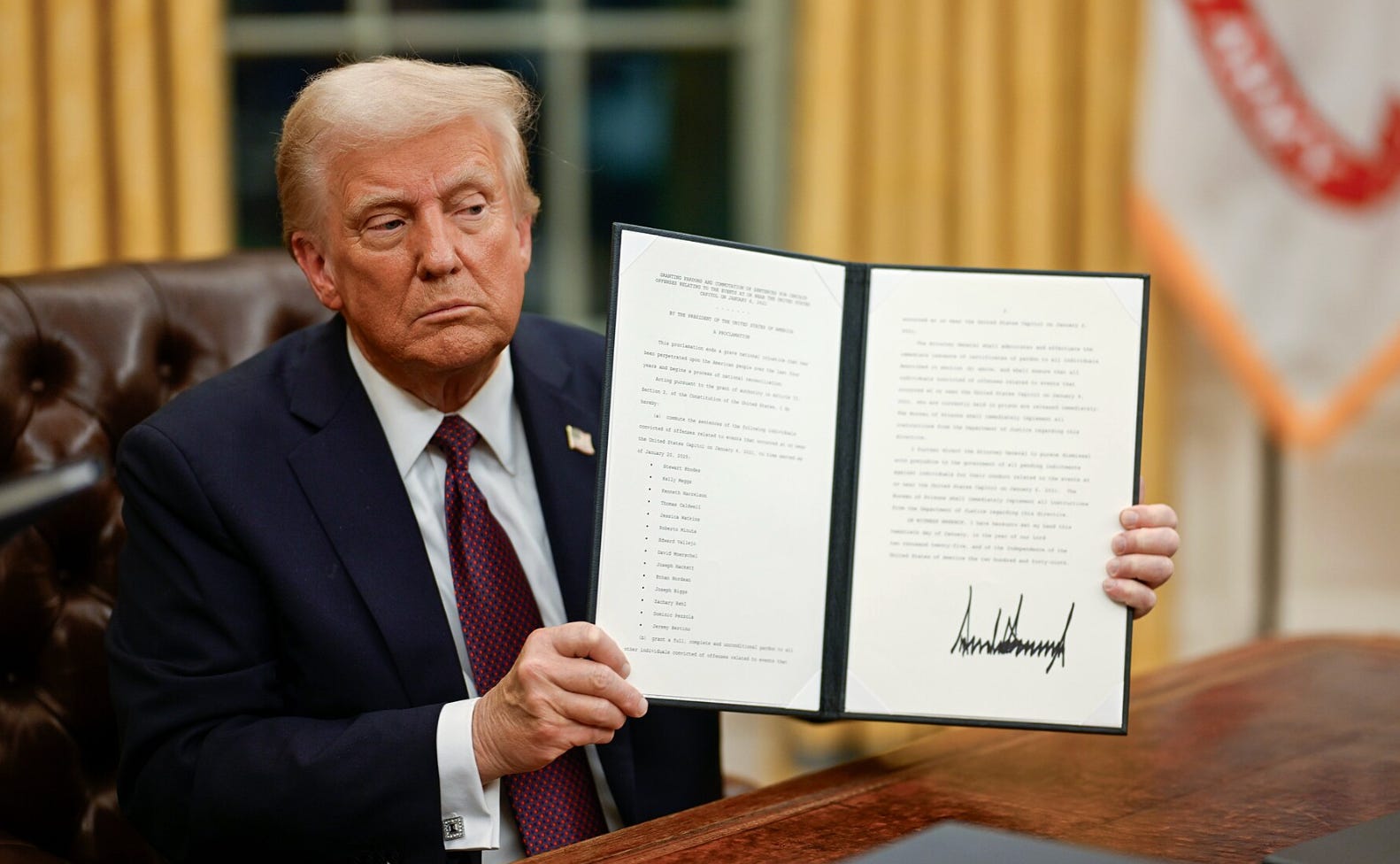
For too long, the presidential pardon power has drifted from its constitutional purpose as an instrument of mercy to a tool of political convenience and personal protection. It is a flaw in our system that has allowed presidents of both parties to place their associates, family members, and political allies above the law.
But there is a bright spot on the horizon. In a rare and welcome display of bipartisan leadership, Republican Rep. Don Bacon has joined with Democratic Rep. Johnny Olszewski to introduce H.J. Res. 135, a constitutional amendment designed to restore checks and balances to this abused authority.
This isn’t about one president or one party. It is about fixing a systemic vulnerability that has eroded public trust in our justice system.
An Equal Opportunity Abuse of Power
To understand why the Pardon Integrity Act is necessary, we must acknowledge that the abuse of the pardon power is a bipartisan failure.
The Trump Era: We have seen the power used to shield political allies and associates, with controversial clemency granted to figures like Steve Bannon and Roger Stone, raising serious questions about the use of public office for personal political gain.
The Biden Era: Trust was similarly damaged when President Biden issued a pardon for his son, Hunter Biden, in 2024 (followed by pardons for the president’s siblings). These actions, protecting family members from federal felony charges, struck many as deeply personal and inappropriate, reinforcing the cynical view that there is a different set of rules for the powerful.
Historical Context: The pattern extends back decades, including Bill Clinton’s last-minute pardon of fugitive financier Marc Rich, whose ex-wife was a major donor.
When presidents use this power to benefit themselves, their families, or their co-conspirators, they are not dispensing justice; they are obstructing it.
The Solution: Congressional Review
The proposed amendment introduced by Reps. Olszewski and Bacon offers a sensible, structural fix. It does not strip the President of the power to pardon, but it subjects that power to transparency and congressional oversight.
Here is how it works, according to the text of the resolution:
Immediate Transparency: The President must notify the Speaker of the House and the President pro tempore of the Senate within 3 days of granting a reprieve or pardon. If they fail to do so, the pardon has “no force or effect”.
The Waiting Period: A pardon does not become effective immediately. It only takes effect 90 days after Congress is notified. This prevents “midnight pardons” issued as a president is leaving office to avoid scrutiny.
Congressional Check: During that window, Congress can introduce a bill to nullify the pardon. If 20 Representatives or 5 Senators sign such a bill, it must be voted on.
The Veto: To actually overturn a pardon, Congress must pass the nullification bill by a two-thirds vote of both Houses.
This high threshold — two-thirds of both chambers — ensures that Congress cannot use this power for petty partisan squabbles. It would require a broad, bipartisan consensus that a specific pardon is an egregious abuse of power.
Why This Restores Trust
The bipartisan support for this measure highlights a critical principle: Accountability is conservative, liberal, and essential. Bacon has previously voiced concerns when crimes or pardons lack transparency, noting that when the system cannot identify or check specific crimes, “that is a problem”.
This amendment restores the pardon to its original intent: a safety valve for justice, not a loophole for corruption. If a pardon is truly just — if it is correcting a wrongful conviction or showing mercy to a repentant citizen — it will easily survive a 90-day delay and congressional review. It is only the corrupt, the personal, and the indefensible pardons that have anything to fear from this process.
By supporting the Pardon Integrity Act, we can ensure that the final word on justice belongs to the people and the Constitution, not the personal whims of any single leader.
Let us be real: This became such a severe problem because of Trump and a subservient Congress and SCOTUS.
Pardons are just one aspect of a system that was put through extreme stress testing where MANY flaws and cracks were found.
We can provide sensible fixes, but not by ignoring ALL the problems and just trying to fix the pardon power in isolation.
Some ideas (Details available):
Pardons: Place limitations on the pardons in the last four months of a term.
Get politics out of SCOTUS, thereby eliminating the 'Unitary Executive theory' and the concept that POTUS can break any and all laws.
Remove or address 'Statutes of Limitations' on POTUS and other 'protected' people.
For functions that can not be partisan such as Inspector Generals, need to NOT be under authority of Executive branch.
FIX the impeachment process so it can work despite partisan politics.
Get money out of politics and Outlaw Lying in politics, with consequences. (Yes, I am serious)
Ensure Congress members ALWAYS have 'standing' on either side of any law and case. They are our representatives and they are the 'lawmakers' and those are OUR laws.
Empower Courts to hire lawyers to prosecute a case, or represent a side of the case that is not being represented if the court feels it is needed.
In a corrupt system, sometimes pardons are the only remaining protection available.
If the pardons are the corrupt act, enable oversight and make impeachment an effective deterrent.
There are MANY more problems that require significant redesign and repair. I have a list, don't you?
If we don't TRY to fix all the problems, we will have a lot of very serious problems that will continue to cause much damage.
Biden didn't pardon hunter to protect him from the law. He pardoned him to protect him from the trump regime. He would have proven himself to be as dottering as trump proclaimed if he hadn't done it.