

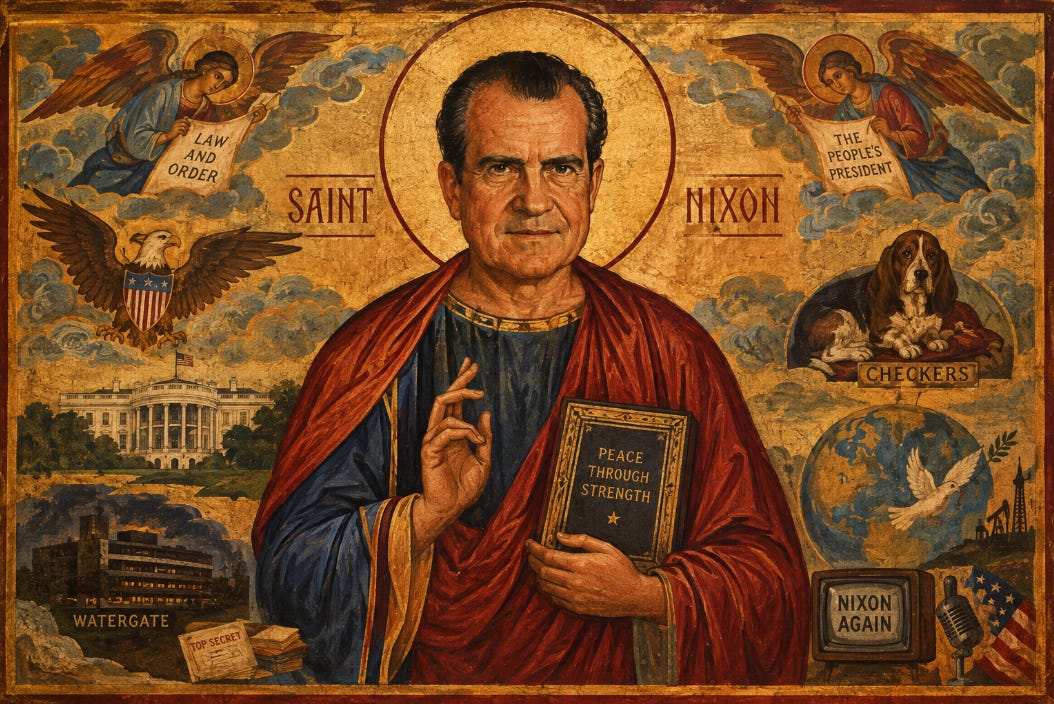
This past summer, Vice President JD Vance stood inside the Richard Nixon Presidential Library in Yorba Linda, California, and said something that should have stopped the room cold.
“If Watergate happened tomorrow, it would be like a 12-hour news story,” he told the audience. “The idea that it would have taken down a presidency is crazy.”
He’s probably right about the news cycle, and that is exactly the problem. If the biggest political scandal of the last century would barely survive a weekend today, it says something alarming about where we are now and nothing flattering about Richard Nixon. One commentator summed it up better than I can, saying it “is a testament to how bad now is, not how bad then was.”
Vance kept going: “If you look at the story of how the deep state took down Richard Nixon, it’s not all that different from what the same groups of people, the same institutions, tried to do to Donald Trump in the first Trump administration,” he said. “There is a parallel.”
It was easy to shrug that off as a politician buttering up his hosts at a presidential library (not to mention buttering up his boss watching at home)… but perhaps we should have realized it was foreshadowing what would happen this fall when the Justice Department decided to run with it.
Investigating the Investigators, Fifty Years Later
On October 1, the Wall Street Journal reported the Justice Department is spending your tax dollars reviewing whether the Watergate Special Prosecution Force committed misconduct. That was the team of prosecutors led first by Archibald Cox, a Harvard law professor, and later by Leon Jaworski, a Texas trial lawyer and former president of the American Bar Association. Both men have been dead for decades, so nobody is going to be charged with anything. The point of the exercise is the story it tells.
The review grew out of a visit from Geoff Shepard, a former Nixon White House aide who has spent much of his life arguing that his old boss was railroaded. According to the Journal, a senior Justice Department official invited Shepard to headquarters in September, where he spent two hours walking officials through a 78-page slide deck titled “Watergate As Lawfare.” His central claim is that Cox and Jaworski met secretly with the judges in the case and kept evidence from defense lawyers. The Biden Justice Department turned down the same request in 2022, noting how much time had passed. This time, officials wanted to hear him out.
A department spokeswoman told the Journal that the presentation “does not constitute an investigation,” and the people familiar with it described the review as preliminary. Still, the setting matters. Shepard made his pitch to the Office of Professional Responsibility, the department’s internal watchdog, which was itself created after Watergate to keep the White House’s hands off criminal cases. The Journal opened its story with a line: “For nearly two years, the Justice Department has made it a priority to investigate people who previously investigated President Trump. Now it is reaching back in history to consider whether prosecutors mistreated an earlier Republican president.”
A Quick Refresher on the Candidate for Sainthood
In June 1972, burglars working for Nixon’s re-election campaign were caught inside the Democratic National Committee’s offices at the Watergate complex in Washington. The break-in was one piece of what the Journal calls a “wide-ranging scheme of political sabotage, wiretapping and illegal contributions.” The cover-up that followed is what brought Nixon down, and most of what we know about it came out of his own mouth, because he had secretly recorded his conversations in the Oval Office.
When Cox subpoenaed those tapes in October 1973, Nixon ordered Attorney General Elliot Richardson to fire him. Richardson refused and resigned. His deputy, William Ruckelshaus, refused too and was out the same night. The job finally fell to Solicitor General Robert Bork, who did the deed. In a memoir published after his death in 2012, Bork wrote that Nixon later promised him the next open seat on the Supreme Court. The whole episode became known as the Saturday Night Massacre, and it failed, because Jaworski took over the investigation and went after the same tapes.
The recordings are hard to explain away. They capture Nixon taking part in the cover-up and talking about using the IRS against his political enemies, with ugly antisemitic and racist rants mixed in. There is also a famous gap of 18 and a half minutes, erased from a conversation with his chief of staff, H.R. Haldeman, three days after the break-in. In July 1974, the Supreme Court ruled 8 to 0 that Nixon had to hand over the tapes. One of them, the so-called “smoking gun,” caught him six days after the break-in directing aides to have the CIA tell the FBI to back off.
Roughly 69 people were charged in connection with Watergate, and dozens were convicted, including Haldeman, top domestic adviser John Ehrlichman, and former Attorney General John Mitchell. John Dean, Nixon’s own White House counsel, famously warned him there was “a cancer” growing on the presidency. Shepard may have found some procedural sins in the prosecutors’ files. Even so, as the Journal notes, mainstream scholars long ago concluded that Nixon, not the people who investigated him, was the one guilty of wrongdoing. If a deep state took Nixon down, it was a tape recorder he installed himself.
The Smoke Detectors Watergate Gave Us
The country learned a lot from Watergate, and it wrote those lessons into law. Congress created the Federal Election Commission (FEC) in 1974 to police campaign money. The Justice Department set up its Office of Professional Responsibility in 1975 and its Public Integrity Section, which prosecutes corrupt officials, in 1976. In 1978 came the Inspector General Act, which put independent watchdogs inside federal agencies, and the Ethics in Government Act, which created the Office of Government Ethics. Think of them as smoke detectors, installed so the next ethics “fire” could be caught early.
The Trump administration has spent the last two years pulling out the batteries. Four days into Trump’s second term, on January 24, 2025, he fired at least 17 inspectors general by email, skipping the 30 days’ notice to Congress that the law requires. A federal judge, Ana Reyes, ruled in September 2025 that the firings were unlawful but declined to put the watchdogs back in their jobs. A few weeks after the inspectors general were fired, Trump removed David Huitema, the Senate-confirmed head of the Office of Government Ethics, along with Hampton Dellinger, who ran the Office of Special Counsel that protects federal whistleblowers.
The list keeps going. The Public Integrity Section had about 30 prosecutors at the end of the Biden administration, and by March 2025 the department was planning to cut it to as few as five after its leadership resigned. In October 2025, the White House budget office cut off funding for the council that supports all the inspectors general, which took down Oversight.gov, a library of more than 34,000 watchdog reports and the home of dozens of whistleblower hotlines. An administration spokesperson explained that inspectors general had become “corrupt, partisan, and in some cases, have lied to the public.”
The FEC, meanwhile, lost its quorum on May 1, 2025, and has been unable to enforce the law ever since. That is the longest stretch without a quorum in the agency’s history, and the pile of stalled enforcement cases has doubled from 154 to 307. In August, Campaign Legal Center analyzed the government’s own ethics data and found falling compliance with disclosure laws, fewer ethics officials, and criminal ethics violations that are going unreported and unprosecuted. As the Journal put it, the president “has moved to roll back many post-Watergate overhauls.” Rewriting the story of Watergate makes that a lot easier to sell.
It Started With a Night Watchman
It’s worth remembering who actually cracked Watergate. A security guard named Frank Wills noticed tape on a door lock and called the police. Two young Washington Post reporters, Bob Woodward and Carl Bernstein, kept digging when almost nobody else would. The government’s own institutions did their part eventually, from the courts to the special prosecutors to a Senate committee, but much of the early work came from people outside the government who refused to look away.
That lesson matters more today, because the watchdogs inside the government have been fired, defunded, or left without enough members to act. And while president may be able to force out an inspector general via email, he can’t fire independent nonpartisan organizations, and he can’t stop it from filing a complaint, publishing what it finds, or taking him to court. Outside watchdogs like Campaign Legal Center (CLC) have become the backup system for a government whose alarms have been switched off.
CLC was founded in 2002 by Trevor Potter, a Republican who once chaired the Federal Election Commission, and it has spent this year doing the work the government stopped doing. Its lawyers pored over federal ethics data that the administration would rather nobody read. They went to court on behalf of people who watch and document immigration enforcement, and they won a ruling that blocked a Postal Service rule threatening mail ballots. None of that requires anyone’s permission in Washington, which is exactly why it matters. Even this latest Nixon story only came to light because reporters at the Journal went looking for it.
CLC is also following the money with its tracker of the Trump administration’s most corrupt transactions, which follows roughly 60 donors, companies and foreign interests that gave to Trump or his causes and then got something back, from cabinet jobs and ambassadorships to pardons and dropped cases.
Why Bother Rewriting a Fifty-Year-Old Story?
The effort to clear Nixon’s name has nothing to do with Nixon. If Watergate can be recast as “lawfare”, then every investigation of a president becomes lawfare, and every check on power becomes a coup by the deep state. That is a very useful story for a president who is still dealing with his own legal history, and for a vice president who is widely expected to run for the job himself in 2028.
In a 1977 interview with the British broadcaster David Frost, Nixon offered his own defense in one famous sentence:
“Well, when the president does it, that means that it is not illegal.”
For decades, that line was treated as a confession of how badly he had lost his way. Now there are people in power who seem to hear it as a mission statement — one that’s been emboldened by the broad presidential immunity recently expanded by the Supreme Court.
Saints are supposed to perform miracles, and Nixon has finally managed one, because half a century after he left in disgrace, he somehow looks good by comparison. The answer is to keep the bar where Watergate set it — and push it higher — to protect the people, inside government and out, whose job is to keep watch. A country that forgets why it installed the smoke detectors shouldn’t be surprised when the house burns down.
Great article well worth reading about the need to protect and defend our democracy and keep speaking truth to power. Well done.