

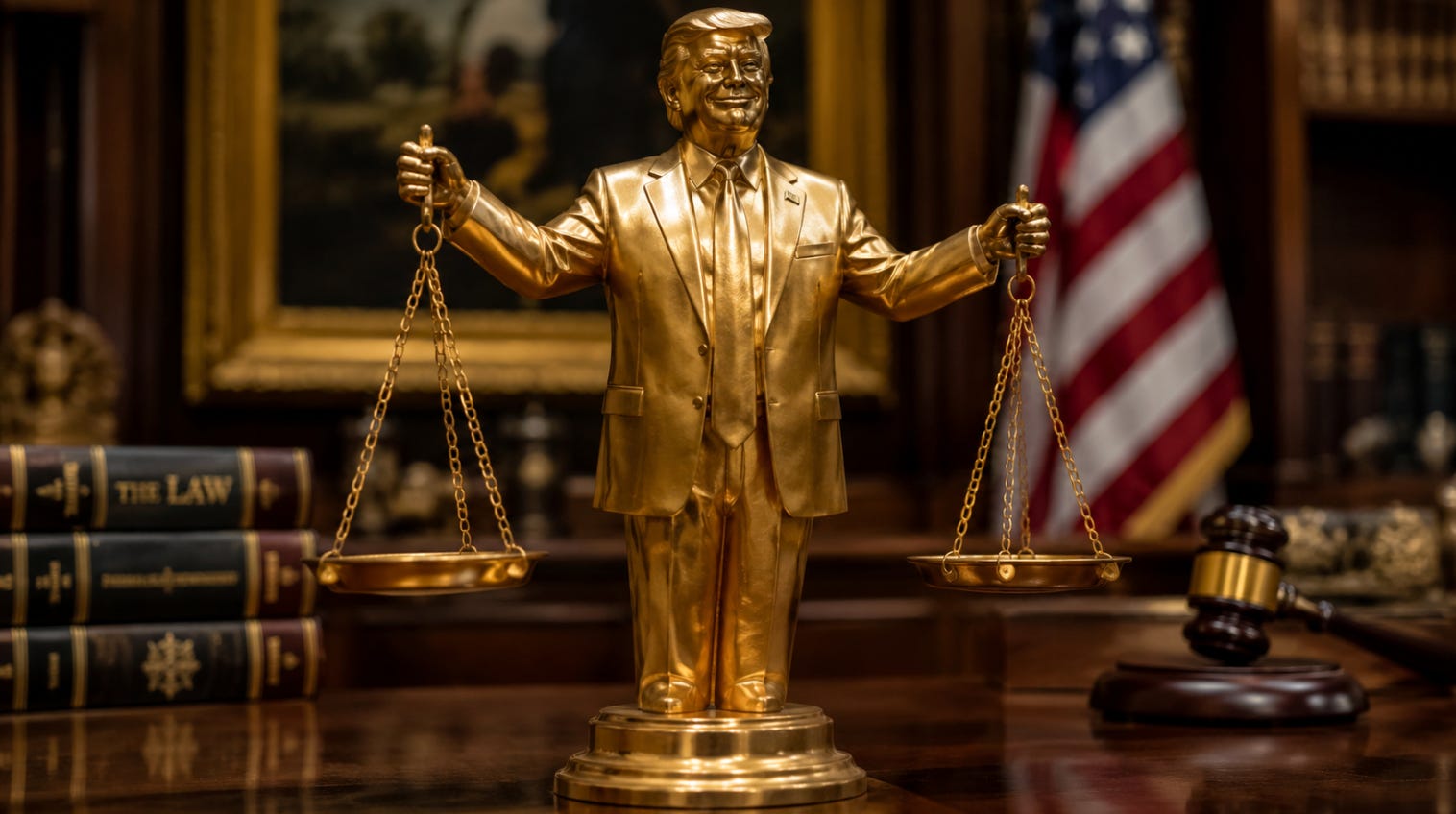
There is a quiet, insidious transition taking place in American life — one that we cannot allow to take hold. It is the shifting of our foundational bedrock from the rule of law — where rules are predictable, public, and applied equally (imperfect as it may be) — to the rule of ONE man, where survival requires anticipating the whims, moods, and personal vendettas of the executive branch.
When a republic shifts from institutional governance to personalized rule, the primary currency becomes fealty, and the primary deterrent becomes fear. Two seemingly unrelated stories from the past week — one involving a stalwart conservative legal nonprofit, the other a cutting-edge artificial intelligence startup — reveal exactly how this chilling effect operates in practice.
Winning in Court, Losing in Business
Consider the Liberty Justice Center (LJC), a nonprofit with a sterling conservative pedigree known for fighting public-sector unions and challenging university DEI policies. Certainly not everyone’s cup of tea, but the group’s commitment to its principles was on fully display when it won the biggest victory in its 15-year history: a Supreme Court ruling that struck down President Trump’s global tariffs, ruling against unbridled presidential power and opening the door for businesses to reclaim billions in unconstitutionally collected funds.
By all traditional metrics of American civic life, this was a triumph for the constitutional separation of powers. But in the current political climate, it was treated as a corporate liability.
The LJC lost over 30% of its donor base simply for taking the case, as conservative benefactors fled the controversy of challenging the administration.
Major corporations like Costco, which stood to benefit immensely from the multi-billion-dollar tariff refunds, explicitly refused to donate to or support the litigation.
Instead of fighting for their constitutional rights, major companies have largely taken a conciliatory path: rolling back “controversial” initiatives, avoiding legal challenges, and even donating to pet projects like the new White House ballroom. When big business decides that building a ballroom for the President is a safer bet than defending the law in court, the rule of law is on the ropes as some seek to replace it with a system of transactional appeasement.
“Bullying Based on Bad Vibes”
If the corporate world is being coerced into silence through financial anxiety, the tech sector is learning what happens when you dare to push back.
Anthropic, an artificial intelligence startup, recently found itself in the administration’s crosshairs. The company had previously clashed with the Pentagon over a $200 million defense contract, leading Defense Secretary Pete Hegseth to retaliate by labeling the domestic firm a “supply chain risk” — a devastating national security designation never before used against an American company. Anthropic responded by doing what citizens in a free republic are supposed to do: they sued the government.
The administration’s retaliation was swift and arbitrary. Recently, executives at Anthropic received a sudden White House directive: they had less than 90 minutes to pull their latest AI models, Fable 5 and Mythos 5, off the market.
“Are we being bullied based on bad vibes?” one Anthropic employee asked in an internal chat. “At what point does this just feel like they don’t want us to exist?”
The justification for the shutdown was entirely inconsistent. The White House cited vague national security flaws based on a single, preliminary paper from Amazon — yet cybersecurity experts note that rival models from companies like OpenAI possess the exact same capabilities but face no such restrictions. Over 150 top cybersecurity experts have signed an open letter calling the administration’s abrupt restrictions unfair, pointing out that Anthropic’s safety guardrails were actually incredibly robust.
When the state can give a successful American company a 90-minute ultimatum to destroy its product line without offering concrete evidence, clear guidelines, or due process, it is no longer exercising governance. It is exercising raw, personalized power.
A Republic of Apprehension
When you lay these two cases side-by-side, a deeply disturbing architecture of modern authoritarianism emerges. You do not need to throw political dissidents into prison to break a republic; you merely need to make the cost of principle too high to bear.
When law firms are blacklisted for taking on government cases, when nonprofits are defunded for winning in the Supreme Court, and when tech companies are knee-capped by 90-minute administrative ultimatums after suing the Pentagon, the message sent to the country is loud and clear: The law will not protect you from the President.
This is how the rule of law erodes. It dies when regular citizens, massive corporations, and brilliant innovators look at a constitutional violation and decide it is safer to stay quiet, bow their heads, and hope they aren’t noticed.
If we want a Bright America, we must remember that the Constitution was designed explicitly to protect us from the whims of a single ruler. If we allow the administration to turn the legal and regulatory systems into a personal weapon of retribution, we lose the very thing that made our economy and our nation great in the first place. The rule of law must belong to all of us — or eventually, it will belong to no one.
A succinct description of the influence of Trumpism on both sides of the issue.
It HAD to get worse before it could get better. It is still getting worse. November 2026, November 2028 and what we do after those dates will determine everything. We already know what Trump will do. We already know how most companies and other institutions will choose.