

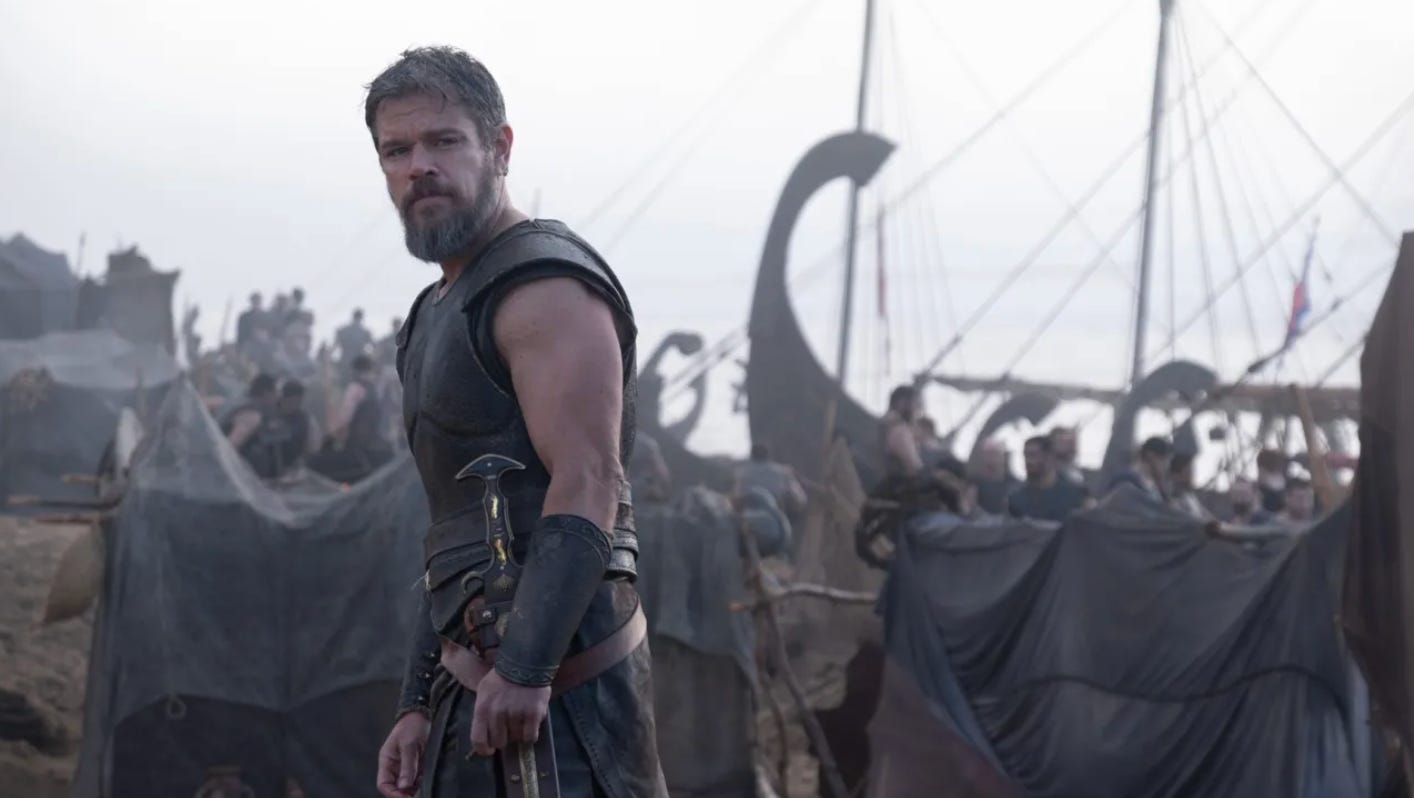
Christopher Nolan’s The Odyssey opens nationwide Friday, and I can’t wait to see it (quite literrally, I bought tickets for Thursday night weeks ago!).
Like others who grew up captivated by these myths, I’m eager to see how Nolan handles the sweeping scale of the epic. But before sitting in the theater, I found myself listening to one of my very favorite scholars, the classicist Mary Beard, walk through what Homer’s poem is actually about. She made a point that hasn’t let go of me since:
On paper, the ending of the Odyssey is a classic story of restoration. Ithaca, in Odysseus’s twenty-year absence, has fallen into deep disorder. Suitors have occupied the palace, depleted its resources, and corrupted the social order. But by the end, the king returns, the interlopers are cleared out, and order is restored.
But Beard points us to a deeper, more realistic truth behind the myth:
“The reordering of Ithaca is a terribly bloody process.”
In a modern context, this isn’t about violence or physical conflict — it is about the sheer, exhausting friction of systemic change. The “suitors” of our democracy — entrenched interests, eroded norms, systemic decay and the minority who benefit from them — won’t just pack up and hand back the keys because we ask nicely. Reclaiming a home takes immense, friction-filled work.
And when the floors are finally scrubbed, the poem reveals that Odysseus doesn’t just sit on his throne forever; he has to keep moving.
Beard reads this not as a tragedy, but as Homer’s honest wisdom: the home you return to is never exactly the same, because you aren’t the same. The very process of rebuilding changes us, tempers our resolve, and prepares us to protect what we’ve built.
A 927-Page Reality Check
That question has been on my mind for a different reason. Four years of this administration is going to leave this country needing a homecoming of its own, and I don’t think anyone who’s watched things closely believes the country simply snaps back to where it was the moment this presidency ends. Too much has been unmade, among them the working assumptions that 1) the rule of law applies evenly, 2) America’s word means something to allies who’ve leaned on it for eighty years, and 3) a judiciary can be pressured but not outright owned.
Underneath all of it, something even more basic has shifted — the assumption that the presidency is not about self-enrichment.
Putting any of that back in order will not be a matter of flipping a switch. It could look more like Ithaca — slow, contested, and expensive, with real arguments about how far is too far.
Consider how far the distance has already stretched. A recent federal financial disclosure showed the President’s holdings grew by $2.2 billion in a single year, with more than half of it flowing from cryptocurrency ventures carrying his own name. The document itself runs a staggering 927 pages.
To put that in perspective:
Barack Obama’s final disclosure ran eight pages.
Joe Biden’s ran eleven.
The current disclosure is nearly a thousand.
Historians say they don’t have much to measure it against. “There is no precedent to compare it with,” as Rice University historian Douglas Brinkley put it.
Nobody has accused the President of breaking the law here, and in a narrow sense, he hasn’t: the presidency is uniquely exempt from the conflict-of-interest rules that force any other senior official into a blind trust. But that is precisely the point made by a group of former White House ethics lawyers — appointees of both parties: the wall between the office and the fortune was never a law. It was a norm. It was upheld by nothing but mutual agreement and the fear of shame. You don’t notice an agreement like that until it’s gone.
The Modern Gerrymander Arms Race
The damage runs across multiple systems at once. Foreign alliances built on trust in American reliability don’t rebuild overnight. A judiciary reshaped over four years doesn’t rebalance in a single term. An anti-corruption enforcement apparatus that was sidelined requires sustained rebuilding, not a quick press conference.
Look at what happened when a divided Supreme Court gutted a core piece of the Voting Rights Act. Within hours, legislatures in Florida and Louisiana were redrawing maps to take advantage of the opening — the acceleration of what election lawyers had already called a nationwide gerrymandering arms race.
Restoring the system means writing these optional norms into hard law. That requires a Congress and a President with the energy and willingness to take on fights that will feel politically costly, and to face a level of backlash we haven’t seen in the modern reform era.
Polarization has already made accountability harder; that is one of the things these past four years have demonstrated most clearly. Reform will require facing sacred cows directly: the campaign finance structures that entrench incumbents, the gerrymandering that makes legislators unaccountable, and the ethics law gaps that made all of this possible in the first place. Half-measures won’t hold.
The Quiet Work of the Loom
Fortunately, the unglamorous work is already quietly underway. Our brilliant strategic litigation partner, Campaign Legal Center, is successfully fighting those gerrymandered maps in state courts right now — in places like Utah, Missouri, and Florida — while pushing for the slower, structural fix: independent commissions that take the pen out of whichever party currently holds it.
None of this makes the evening news. But it’s exactly the kind of institution-by-institution, statute-by-statute work that turned Watergate into the Federal Election Commission and the campaign finance rules (eroded as they may be) we still use today. A country can legislate its way back into an ethical house. It just requires good people doing the right thing — easier said than done, but intuitively possible.
This is where the Odyssey offers its best, most overlooked lesson:
Odysseus isn’t the only one doing the work of coming home. While he is gone for twenty years, his son Telemachus — played by Tom Holland in Nolan’s version — grows from a boy nobody takes seriously into a man capable of standing beside his father when it finally matters. Meanwhile, his wife Penelope spends years outlasting suitors who assume she’ll eventually hand over the house, famously weaving a burial shroud by day and quietly undoing it by night, buying the precious time the household needs to survive.
Neither of them gets the grand statue or top billing — but neither of them wastes the years they’re given, either.
That is closer to what rebuilding actually looks like. It isn’t one dramatic, cinematic homecoming. It is years of steady resistance by people who refuse to give the house away before there is anyone home to defend it. Somewhere in small rooms on Capitol Hill right now and in judge’s chambers across the country, mostly out of view, that is exactly what’s happening.
The House We Build Next
This is the deeper truth of the Odyssey. Beard’s observation — that the home you restore is never quite the home you remember — doesn’t have to be a warning of failure. It can be a promise of progress.
We cannot simply roll back the clock. We can neither pretend the last two years didn’t happen, nor that we should try returning to a flawed status quo. Democracy was never meant to be preserved in amber — it is a living, breathing thing that must be constantly fortified, repaired, and made more resilient.
Our goal shouldn’t be to merely crawl back into the old house. Our goal must be to build a stronger one.
The hope doesn’t lie in a passive wish that everything will just snap back into place. It lies in the deliberate, active preparation of people who are ready to do the heavy lifting:
Drafting the blueprints now. Writing the legal frameworks and closing the ethics loopholes while we have the quiet hours to get the details right.
Gathering the crew. Building the broad, resilient coalitions that will be ready to act the moment the window of opportunity opens.
Cultivating the will. Reminding ourselves that the unglamorous, day-to-day defense of our institutions is the most powerful way to shape the future.
This is the work of our movement, and we can use your help:
Odysseus didn’t just stumble onto the beach and hope for a miracle. He took a breath, surveyed the damage, and trusted the people standing beside him. He knew that taking back his home would require everything he had — and he prepared accordingly.
The work ahead is massive, but we are not starting from scratch. The plans are being drawn. The alliances are forming. The looms are moving in the quiet hours.
We know exactly what we are walking into. And we are ready to build.
The rebuilding will be possible ONLY if Democrats gain meaningful majorities in the house and senate in the midterm elections. If the Republicans maintain ANY semblance of control then all is for naught. This is not normal times where voting your party line is the goal. THIS is a time when repair and rebuild of our damaged republic is paramount. Which is more important to you....saving our democratic republic or continuing down the path of destruction that the Republicans have charted?
Realistic, hopeful, insightful. Thank you.