

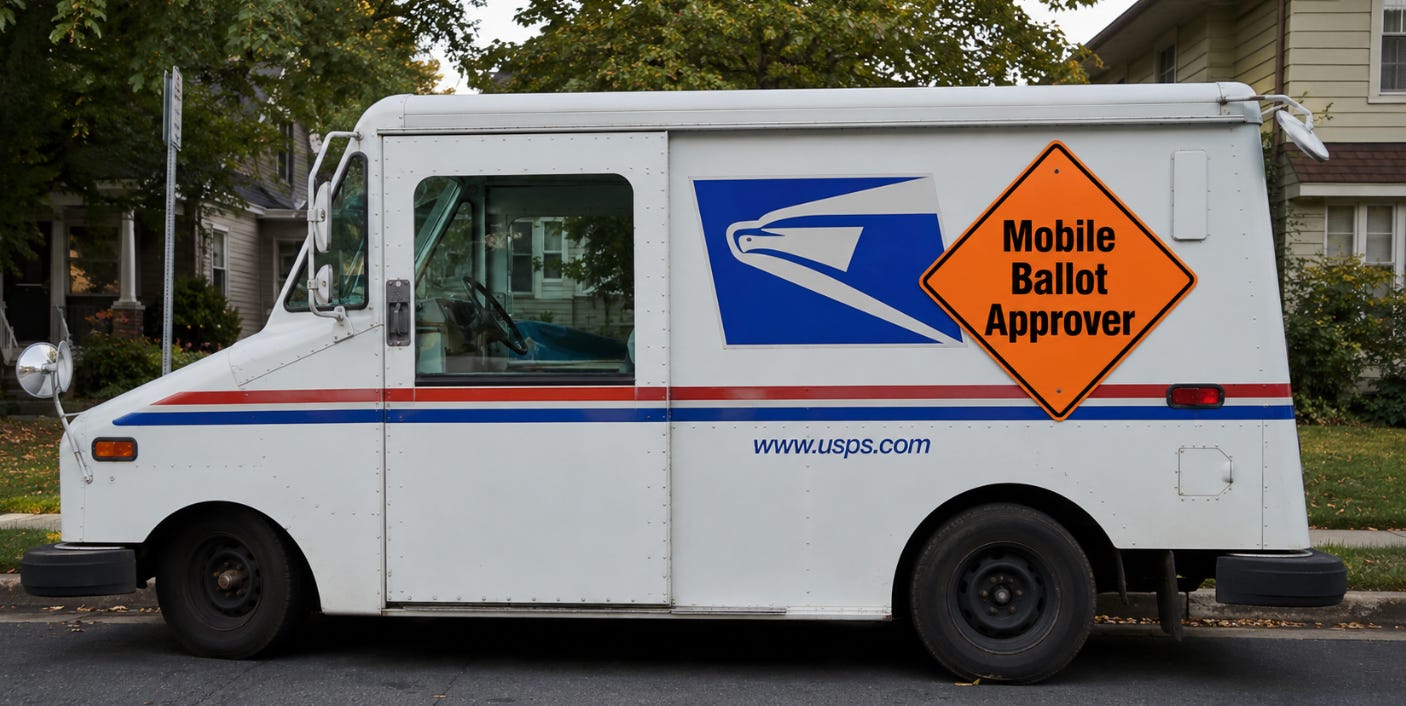
On Monday, the Supreme Court gave the Trump administration something it had been asking for, and by Tuesday (yesterday), our strategic litigation partner Campaign Legal Center (CLC) had already filed a 71-page lawsuit in response. I want to walk through both of those things, but I’m going to spend most of my time on the second one, because that lawsuit is where the real fight is happening now.
Let’s start with what the Court did.
Back in March, President Trump signed an executive order that does two things that should sound strange to anyone who has ever voted. The first part tells the Department of Homeland Security to build federal lists of who counts as a citizen (from a trove of haphazardly compiled and often erroneous data). The second part tells the United States Postal Service, the same people who deliver your catalogs and birthday cards, to stop delivering mail ballots to anyone whose name doesn’t match up with the new, faulty system.
Twenty-three states and the District of Columbia sued to stop it. In June, a federal judge in Massachusetts blocked the order, explaining that the Constitution explicitly gives the job of running elections to the states and to Congress, not to the president. She also pointed out that the government had offered no evidence at all of fraud in mail voting, which was supposed to be the whole reason for the order. An appeals court agreed with her. The administration then rushed to the Supreme Court on its emergency docket, and on August 24th a 6-to-3 majority lifted her block.
It’s important you don’t stop reading now, because this is the part that matters most and a lot of the news coverage got wrong.
The Supreme Court did not say the president’s executive order is legal. What it said was that the states had sued too early, before the Post Office had actually written its rules, so there was nothing concrete enough yet for anyone to be harmed by. The unsigned opinion even added that nothing about the decision “means that any measure taken by the Government to implement the Order will necessarily be lawful.” In the Court’s own words, “On that score, time will tell.”
Justice Ketanji Brown Jackson, writing for the three justices who disagreed, warned that the majority “needlessly injects chaos and uncertainty into the upcoming midterm elections.” I think she is right about that, but the majority’s own careful wording is the thing worth holding onto. The justices answered a question about timing, and they left the bigger question about power for another day.
The funny thing about a timing problem is that it tends to fix itself.
The Postal Service put out its final rule on Friday, August 21, and it was printed in the Federal Register today. The “too soon” argument that won the government its victory at the Supreme Court has now disappeared, because there is an actual rule on the books that anyone can read.
That is why, less than a day after the Supreme Court acted, our strategic litigation partner CLC filed a new complaint in federal court. This is exactly what Bright America members are funding with donations and subscriptions!
From “Bad Idea” to “Absurd Idea”
Under the Post Office’s new rule, before a state can mail out a single ballot, its election officials have to log into a brand-new website called the Federal Ballot Mail Portal and enroll every mail voter by name and address. Each voter then needs a special Postal Service barcode on the envelope going out and a second one on the envelope coming back. Every batch of ballots requires its own separate upload. If a barcode on an envelope doesn’t match a name on the list, the Post Office refuses to take it and sends it back to the clerk.
The portal, as I write this, does not exist yet.
Most states have laws dictating when they have to start mailing ballots (for example, North Carolina, by law, has to start mailing ballots on September 4). The rule also says that Post Office workers will scan those barcodes one at a time at the loading dock; that scanning “generally takes less than a minute per mailpiece”; and that the election official should stay on site while it happens. The complaint does the math for us. Maricopa County, Arizona, expects to send about 2.6 million pieces of mail in its first batch of ballots. At one minute apiece, the county recorder would be standing at the postal facility for nearly five years. Even at one second apiece, it would take thirty days.
Madison’s clerk has already bought every envelope she needs for November. Those envelopes don’t have the new barcode, and she has no legal power to redesign them, because Wisconsin’s statewide system controls the design. Reprinting them would cost more than $10,000 that the city has already spent once, and the supplier needs three to nine months of lead time she simply doesn’t have before her September 17 mailing date. Over in Travis County, the barcodes the clerk already uses aren’t compatible with the Post Office’s format, and her scanners can’t read the new kind.
None of this is a guess about what might go wrong. It is what happens when you ask a mail carrier (that can barely deliver the mail) to run an election with ten weeks’ notice.
The lawsuit makes eight separate legal claims that can be summed up in a few bullets:
☑️ CLC argues that the Postal Service has no constitutional authority to write election rules at all, because the Constitution hands that job to the states and to Congress.
☑️ The rest of the claims go after the Post Office rule under ordinary administrative law.
☑️ The Post Office, which would be refusing to carry some Americans’ ballots, is breaking its own legal duty to serve everyone.
☑️ A claim under the Voting Rights Act that turning ballots away at the Post Office amounts to refusing to let eligible voters vote.
More than 200,000 people wrote in to comment on the proposed version of this rule over the summer, and the Postal Service changed almost nothing in response.
Anna Baldwin, who leads voting rights litigation at CLC, called the Supreme Court’s order “lawless” and said her team “will not let the president’s dangerous anti-voter agenda go unchecked.”
The president’s executive order remains unconstitutional, and the Postal Service cannot launder it into a rule that blocks mail ballots weeks before an election.
Sarah Streyder of Secure Families Initiative pointed to the particular cruelty of making it harder for deployed troops and their families to vote from overseas, since those are exactly the people who depend most on mail ballots.
I’ll say the part that everyone in this fight already understands. From the very beginning, the administration’s strategy has been to run out the clock. If the rule comes out late enough, no court can fully stop it before ballots go in the mail, and the confusion does the rest of the work on its own. The Supreme Court’s timing decision, whatever the justices meant by it, fit that strategy perfectly.
And what CLC, with our movement behind them, did on Tuesday was refuse to let the clock decide the whole game. They filed on the very day the rule became something a court could review, in front of the same judge in Washington who told them back in the spring that they would have to wait for a final rule. Now there is one, and they are back in his courtroom.
If you vote by mail this fall, I have two practical suggestions. Nothing about Monday’s decision changes your ability to request or cast a ballot right now, so don’t let the headlines scare you off. And given what the Postal Service is being asked to do to itself, request your ballot early and send it back early. The people who run your county’s elections are already doing their part, and so are the lawyers.
The least the rest of us can do is not wait around.
“The games people play”…intentional and abhorrent…”never saying what they mean, never meaning what they say.” Thanks for doing the math that J.Roberts is fully capable of doing and, obviously clearly capable of intentionally ignoring (same, it seems, for egregious ethics violations within his court and his own actions).
Thanks so much for the clear, cogent explanation. Hopefully that will undue some of the damage the administration is trying to commit.