

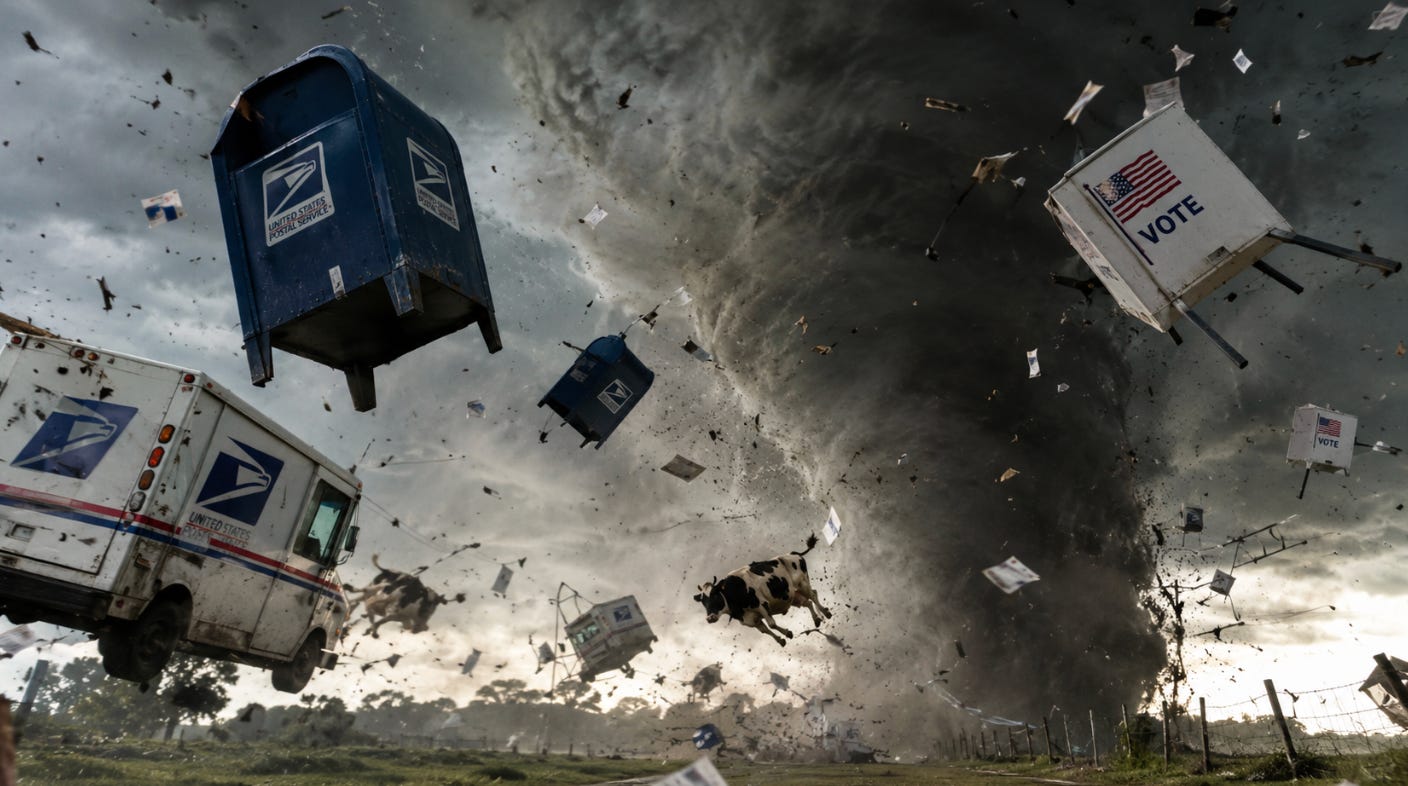
I’ve sat on both sides of an election. As a precinct chairman, I watched poll workers execute a process they’d trained on for months. As a congressional chief of staff, I worked with county officials who plan mail ballot logistics a year out — not a season out. Elections are powered by preparation. So when you change the rules at the last minute (in the name of “security” - ha!), what you create is confusion.
And confusion is exactly what you need to breed if you’re needing to discredit an election.
That’s what’s happening right now.
On August 21st, the U.S. Postal Service published a final rule reshaping how mail-in ballots move through the system, including a new authority for itself to reject ballots before they even get to an election official. A federal judge in Massachusetts blocked it September 4th, but the Administration refuses to back off. It went to the Supreme Court this week asking to implement the rule anyway, with a ruling possibly landing within days.
Our strategic litigation partner Campaign Legal Center (CLC), along with roughly two dozen states, are suing over this. The arguments are obvious and should prevail: the Constitution gives states and Congress power over elections, not the president, and USPS is supposed to answer to voters, not the West Wing. CLC already beat back one Trump election order in court — and we’re confident this will be the next.
Here’s what still has me worried: County election offices don’t get to wait for the Supreme Court to sort this out before printing ballots and setting up mail processing. Some of them are already deep into midterm prep. A last-minute ruling either way forces them to scramble, and scrambling is where mistakes happen. And every mistake becomes a talking point for someone who wants to argue the result was rigged.
Republican and Democratic election officials alike have said their systems already work. The people running elections on the ground are the ones telling Washington to leave the process alone this close to a vote.
An independent judiciary exists for exactly this moment — to decide whether the executive branch can rewrite election rules by fiat weeks before Americans vote, without turning the decision into a campaign issue. CLC is putting that question in front of the courts on behalf of every voter, not one side’s voters.
The strength of American elections has never been that they’re perfect. It’s that they’re stable enough for people to trust the count. If we allow anyone to mess with that stability this close to Election Day, we open the door to chaos, and chaos is the one thing nobody in this fight can afford.
While law suits are happening I think about the people at the head of USPS that thought this was a good idea to agree to use the mail system against the citizens of our country. We have held them up time after time that the republicans wanted to defund them and send them packing and now they do this! I’m furious and I want to see everyone involved charged with violations of our constitution and remove every last one of them from their positions as participating in insurrection and attempted coup