

BY TREVOR POTTER
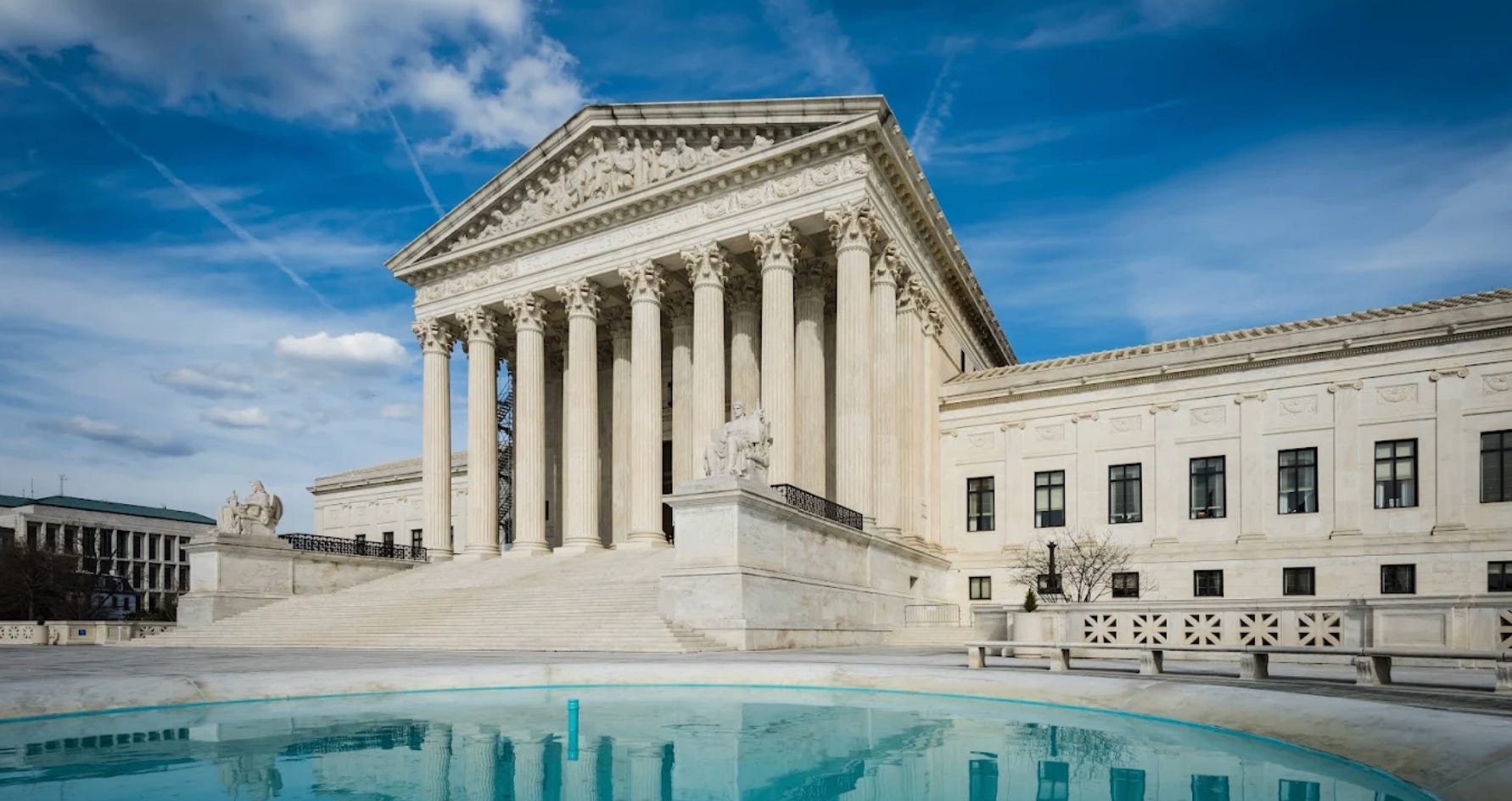
In the last week of its term, the U.S. Supreme Court issued several decisions of critical importance to voters and our elections. Campaign Legal Center filed legal briefs in connection with each case, urging the justices to uphold the rule of law, the Constitution’s separation of powers, and a more inclusive, transparent and accountable democracy.
The results, in the end, are decidedly mixed. The Court deserves little praise for the meager number of pro-democracy rulings it issued; those cases involved questions that were cut and dry, according to the vast majority of legal experts, and yet still produced dissents. On the other side of the ledger, the Roberts Court majority continued down a well-trodden path of rejecting long-established precedents with rulings that further tip the scales in favor of powerful special interests at the expense of the public interest.
The legal rationale for these rulings will be the subject of ongoing analysis and debate in the coming days and for years to come. What may matter most in a practical sense is how these decisions will impact Americans’ ability to cast a ballot and make their voices heard as part of the democratic process.
Watson v. Republican National Committee
In our democracy, every voter who casts a ballot according to the rules in their state must have their vote counted. This includes ballots that are postmarked by Election Day and received by the absentee ballot deadline established by a given state.
In a 5-4 ruling, the Court preserved the authority of states to set these deadlines themselves. Had this decision gone the other way, laws in 30 states allowing ballots in federal elections to be received after Election Day could have been invalidated, causing confusion and chaos just months before the midterm elections.
The majority opinion cites a portion of the Electoral Count Reform Act (ECRA) of 2022 in explaining its reasoning. Campaign Legal Center played an integral role in the bipartisan passage of the ECRA, which includes crucial safeguards to ensure the peaceful transfer of power from one president to the next. The law explicitly acknowledges states’ authority to set ballot deadlines and does not impose national rules that supersede those deadlines — which CLC highlighted in an amicus brief we filed in this case alongside our partners at Protect Democracy.
Trump v. Slaughter
The issue at the heart of this case was the president’s power over federal agencies that are designed and empowered by Congress to operate independently.
The Court’s 6-3 ruling says that laws restricting the president’s ability to fire the heads of regulatory agencies are contrary to the founder’s intent that the president have full control over the functioning of the executive branch (and holding that the functions of the Federal Trade Commission (FTC) and similar agencies are part of that branch). This opens the door for this president, and those who follow, to remove top regulators for virtually any reason, including failure to adhere to a particular political or policy agenda.
Justice Sonia Sotomayor, reading her dissent from the bench, criticized the majority for extending a “maximalist view of presidential power,” reportedly looking often at Chief Justice John Roberts as she did so.
In 1991, President George H.W. Bush appointed me to the Federal Election Commission (FEC), an agency designed to operate independently from the White House. As a Republican commissioner, I refused to attend reelection strategy briefings at the White House on the basis that the FEC’s role was nonpartisan. The idea that President Bush, or any other president, would try to interfere with the agency’s work was unthinkable.
Now, with the threat of arbitrary removal hanging over the heads of independent agency commissioners, we enter a world of uncertainty, where political considerations could override the public interest and well-reasoned expertise on a wide range of impactful regulatory decisions.
Remarkably, on the same day as Slaughter, the Court issued a ruling in Cook v. Trump that exempts members of one independent agency — the Federal Reserve Board — from this dangerous expansion of executive power. Giving the president the ability to randomly fire Fed governors, according to Chief Justice John Roberts, would be “an interpretive leap out of step with the statute Congress enacted and our Nation’s tradition of central banking protected from political interference.”
Nowhere does Roberts explain why Congress can constitutionally establish an independent federal banking agency but not an independent FTC and other similar independent agencies. It is not hard to see the flaw in these divergent rulings — the Court refuses to defer to the policy decisions made by Congress and gives itself the right to decide which agencies deserve protection and independence.
Campaign Legal Center’s analysis of the Slaughter and Cook rulings is ongoing, focusing on what this could mean for agencies that play a role in our electoral process.
NRSC v. FEC
The Supreme Court has infamously empowered wealthy special interests to have outsized influence on our elections, a dynamic that kicked into overdrive following the Court’s 2010 ruling in Citizens United.
Until today, however, the Court had upheld limits on election spending by political parties in coordination with a given candidate. By extension, this campaign finance law restricted the degree to which wealthy special interests could use political parties as a conduit to funnel even larger contributions to candidates for office and our elections.
With a 6-3 opinion, the Court has wiped away this sensible guardrail, further expanding an umbrella of First Amendment protection for election spending at the expense of the public’s vital interest in limiting political corruption.
There is good reason to be alarmed about the nullification of these coordinated spending limits. Political parties are allowed to accept much larger donations than individual candidates. When the parties coordinate their spending with the campaigns of particular candidates, it’s no different than giving the campaigns the money directly.
Indeed, as Justice Elena Kagan noted in her dissent, a typical coordinated spending situation involves a candidate’s campaign simply sending the party invoices for spending that the campaign has completely controlled, leaving the party less a “collaborative speaker” and more a “simple piggy bank” for the candidate.
The Supreme Court’s decision thus creates a new campaign finance loophole that turns political parties into yet another vehicle through which wealthy donors can direct truckloads of cash directly to benefit their preferred candidate’s campaign.
Trump v. Barbara
In this case, the Court, by a narrow margin, struck down a Trump executive order issued on the first day of his second term that would have completely upended the 14th Amendment’s guarantee of citizenship to nearly everyone born in the United States.
As explained in the friend-of-the-court brief Campaign Legal Center submitted, the 14th Amendment’s birthright citizenship guarantee is the key that unlocks equal membership and participation in our democracy. A ruling upholding the executive order would have rendered millions of Americans effectively stateless, depriving them of the rights and privileges that come with citizenship, including the right to vote in federal elections starting at the age of 18.
While the Court majority reaffirmed long-standing precedent and the plain text of the Constitution that birthright citizenship is the law of the land, four justices took the deeply troubling position that nothing in the U.S. Constitution prevents attempts like the one undertaken by the president to strip U.S.-born children of their citizenship and lock them out of the franchise.
An alarming 5-4 vote on the plain meaning of the 14th Amendment is yet another sign that we must remain vigilant against further attacks on fundamental principles of democratic equality.
Taking stock of the latest term
So ends one of the most consequential U.S. Supreme Court terms for our democracy. On the whole, the Court’s rulings in this area of the law have hindered Americans’ ability to express their political preferences through the electoral process. We must not forget that prior to this last round of decisions, the Court dealt a mortal blow to the Voting Rights Act and sanctioned the pursuit of partisan political goals as a justification for gerrymandering.
While the Court ultimately landed on the right side of the law and the Constitution in some of these final cases, to have done otherwise — on birthright citizenship and vote-by-mail in particular — would have been indefensible. Such beyond-the-pale decisions would have made the Court even more vulnerable than it already is to accusations of political and ideological bias.
Regardless of how the Court rules on future cases, Campaign Legal Center will remain committed to our core mission of advancing democracy through law. When this Court throws up roadblocks to the pro-democracy agenda, we will pursue every legal and policy avenue available to ensure Americans can exercise their fundamental right to fully participate in the democratic process.
Looking for more in-depth insights on issues critical to our democracy? Consider subscribing to the “From the Desk of Trevor Potter” newsletter, written by Campaign Legal Center’s founder and president, Trevor Potter. Get expert analysis and learn more about Campaign Legal Center’s efforts to protect and strengthen democracy for all Americans by subscribing via email or on LinkedIn.
When this court makes a decision that is contrary to the constitution we do not have to follow it. Just like our troops, if they get an illegal order they don’t have to follow it. So why are we going along with all this shit! We have 6 justices, a president, vice president and cabinet as well as appointees that all need to be removed from office. I do not believe we can wait until November. Look at the groundwork this crazy ass was spewing on July 4th about communism. All familiar I know but seriously he is laying groundwork to fuck with elections because he will lose in a fair one. How many states turned over their voting roles with all private information 🤷♀️ this is some seriously crazy bad shit! And the SC is right in the middle of it. They must all know they’ll be gone soon. Apparently even the bar association won’t take on Robert’s wife’s illegal dealings and his illegal reporting of her income. 😖 when do we get some balls and start standing up to this shit? The residents of MN have put us all to shame on that score. I know it’s scary but we need to join forces and stand behind one another and go after this shit
Fire when ready!