

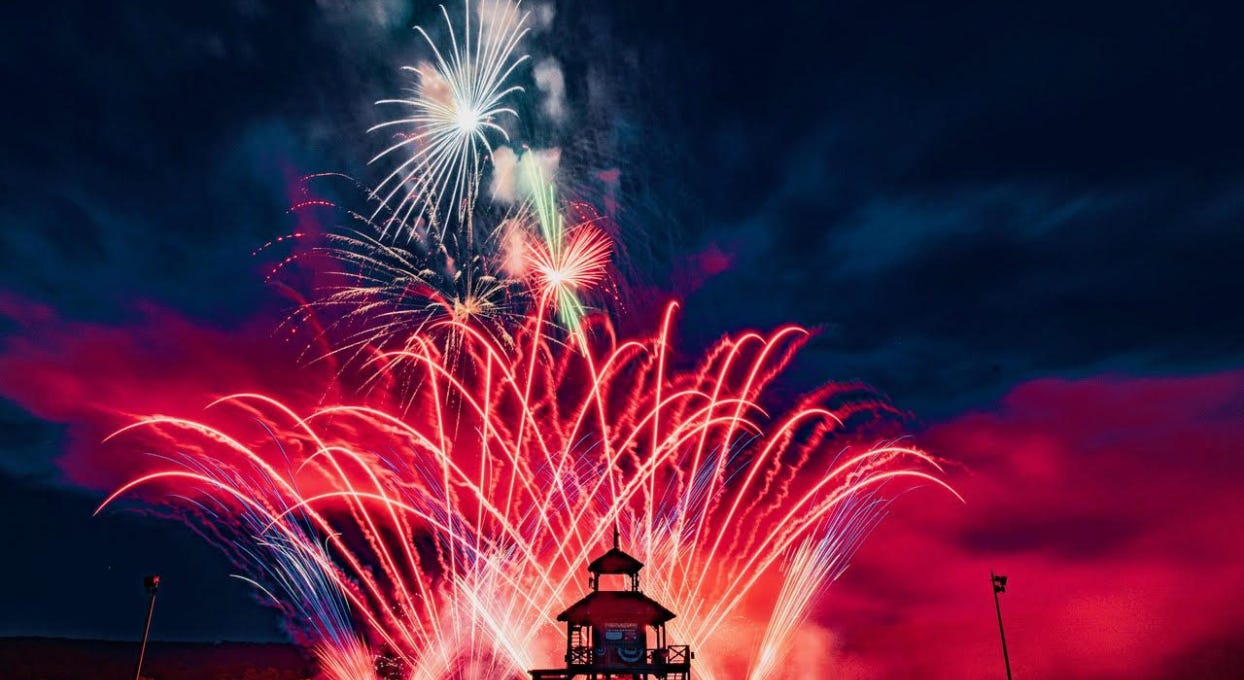
A few nights ago, from a damp field in rural Virginia about an hour outside Washington, I watched my seven-year-old daughter look at the sky the way you only get to a few times in a lifetime. Both her hands were wrapped around mine, an expression of awe on her face, absolutely certain the fireworks were performing just for her. A sudden summer storm had rolled through that evening, cooling the air and sweeping away the July haze. It left behind the kind of clear, open sky anyone could appreciate.
It was America’s 250th birthday. And for one night, in that quiet field, it actually felt like it.
The Party in Washington
Two years ago, I was appointed executive director of what was then still called — with typical bureaucratic grace — the Semiquincentennial Commission (aka America 250). I came to the role naively ambitious. I genuinely believed the 250th could be a rare, unifying moment when the country finally showed up for itself — a year when Americans of all stripes could look past the noise, return to the plain language of the Declaration, and agree that the ideas underneath it were still worth the trouble.
I knew going in how fiercely contested that narrative already was. I remember The New York Times dedicating an episode of The Daily to that exact tension, tracing how our founding myth has been claimed, weaponized, and reclaimed by the left and the right — from Frederick Douglass’s generation to our own. But I still believed we could find our way to a shared, honest version of our story — one that acknowledged our deepest failures while remaining aimed at the country we still have time to become.
I expected whoever held the White House this year to put their own stamp on the day; every president does. What I did not expect was that a decade of painstaking, nonpartisan planning would be shoved aside to make room for a one-man show. And I certainly didn’t expect a modern crusade against communism to become the centerpiece of our nation’s 250th anniversary. From a stage at Mount Rushmore on the eve of the Fourth, the rhetoric warned of a “communist menace” painted as more dangerous than the existential wars of the last century. It felt small. It felt exhausted. It felt beneath us, and all who came before.
The 250th Somewhere Else
But the real anniversary happened somewhere else, entirely away from the teleprompters.
In New York Harbor, forty-eight tall ships from twenty nations cut through the water past the Statue of Liberty for Sail4th 250 — reviving a grand tradition President Kennedy first championed, which our country now brings back once a generation.
In Philadelphia, even after the official parade was called off, “America’s Time Capsule” was quietly lowered into the ground on Independence Mall. It is a nine-hundred-pound, watertight cylinder holding a Pennsylvania governor’s letter, a Phillies lineup card, and handwritten notes from schoolchildren across the country, sealed until the year 2276.
Someone has been keeping this national chain letter running for a century and a half. We buried a capsule for 2076 during the Bicentennial, and another during the Centennial in 1876, which was dug up by Gerald Ford exactly fifty years ago. It is a quiet, continuous act of faith in our own future.
Meanwhile, in Los Angeles, a massive benefit concert raised millions for charity rather than a politician, selling tickets for exactly $17.76. And because the 250th collided with the World Cup this summer, the timing became an unexpected gift. All month, international visitors have been discovering local diners, ranch dressing, gas-station slushies, and the particular American genius of the free refill, while Americans have realized the rest of the world showed up just wanting to celebrate with us.
The Daily ran another episode recently, noting that the tournament’s best story was happening entirely off the pitch, as a wave of global visitors and their hosts really looked at one another for the first time in years. Boston offered the purest glimpse of this: Scottish soccer fans took over the city’s historic pubs, marched en masse to Fenway Park, and left behind so much genuine goodwill that Boston and Glasgow are now, officially, sister cities.
The Mirror of 1976
None of this cultural resilience is entirely new. Fifty years ago, the country limped into its Bicentennial deeply bruised. We had just watched a president resign in disgrace to avoid impeachment, pulled our last helicopters out of a generation-long war in Vietnam, and watched inflation eat away at every paycheck in the wake of crippling energy shocks.
Historians look at the parallels between 1976 and 2026 and find them eerie. A different fight over executive power stands in for Watergate; a different set of messy overseas commitments stands in for Vietnam. Even the commercialization was a headache back then — corporate sponsors piled onto the Bicentennial so aggressively that critics mocked it as the “buy-centennial.”
And yet, out of that cynical mess, the country built things that actually lasted. The National Air and Space Museum opened its doors that same July. New museums dedicated to Black and Native American history were sparked by the anniversary and opened shortly after. Thousands of ordinary towns used the milestone as an excuse to restore a crumbling local courthouse or schoolhouse. A messy national mood and a real civic renewal are not mutually exclusive. We have done this before.
The political incentives of our current two-party system simply do not reward renewal. They reward holding your ground, screaming louder, and solving nothing.
Until that structural reality changes, we will continue to get louder anniversaries and smaller results. The fix isn’t complicated to describe, even if it is agonizingly hard to execute: root out the systemic corruption that is hiding in plain sight, take the dark money out of the decisions that reward political gridlock, and close the gap between what America promises on paper and what it delivers in practice. Do that, and institutional trust will return on its own.
But until that day arrives, two things cannot be treated as optional:
1) Free and fair elections, and
2) A culture willing to abide by their outcomes.
These are are the absolute floor upon which everything else stands. There is no better version of America without it.
A Promise in the Ground
My daughter doesn’t know anything about partisan incentives, executive overreach, or bureaucratic misfires yet. Saturday night, she just saw the sky fill with golden light and understood, instinctively and correctly, that it was beautiful, and that it was for her.
There is a sealed cylinder resting under the stone of Independence Mall right now that will not see the light of day until 2276. It is a promise, buried in the dark, that Americans will still be here to dig it up. And as cool as the idea may be that people 10 generations from now may look back on our lives with interest or amusement - who cares?
Instead of burying something for the future, let’s build a more perfect union for them instead — a country worthy of the staggering wager made 250 years ago, and all that’s been spent to secure it since.
What a powerful article and reminder of where we are and where we came from as a nation. Just as important is the boot in the backside for where we can still go, and why we should want to go there. Thank you, we'll done.