

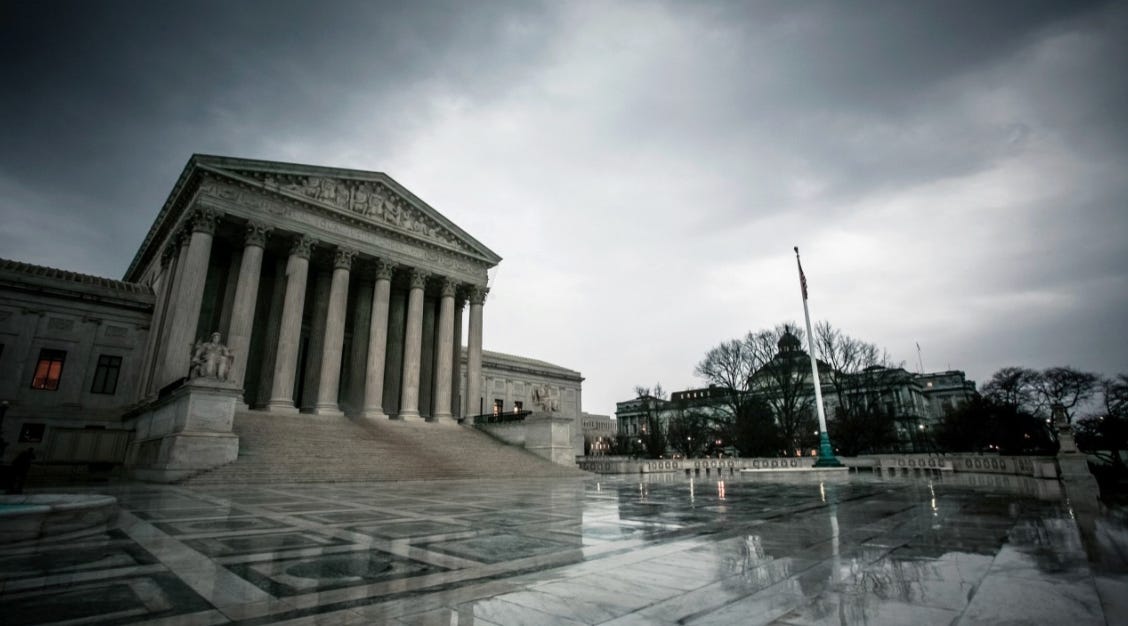
For more than a decade, legal experts and court watchers have been predicting the demise of the Voting Rights Act (VRA) at the hands of the U.S. Supreme Court led by Chief Justice John Roberts, but foresight does not make the reality of what happened in the final days of April any easier to absorb. A 6-3 majority handed down an utterly disastrous and disingenuous ruling on April 29 in Louisiana v. Callais. In the hours following this ruling, Campaign Legal Center Senior Vice President — and noted voting rights attorney — Bruce V. Spiva, released a powerful statement condemning the majority’s decision.
The case that produced the Callais ruling centered on Louisiana’s congressional map, where, in 2024, Black Louisianans, who make up a third of the state’s population, were able to elect two representatives of their choice for the first time in history. Louisiana has six members of Congress. The map that enabled this was put in place after a successful legal challenge under Section 2 of the VRA.
The majority’s ruling overturning this fair map (which CLC argued against in two amicus briefs) has broad implications that could produce the largest drop in Black representation in Congress our nation has ever witnessed.
Before Callais, the bar for successfully challenging racial vote dilution — the legal term for implementing racially discriminatory voting maps — was substantial but achievable to remedy egregious violations. Now, while Section 2 still technically exists on paper, it is a “dead letter,” as Justice Elena Kagan wrote in her dissent.
The Supreme Court has, in essence, rewritten a law passed by Congress in 1982, which explicitly added a results-based test to the VRA for proving that maps are discriminatory. But according to the Callais ruling, proving that a map results in racial discrimination is no longer sufficient. Instead, plaintiffs must essentially demonstrate that the sole intent behind the creation of a new voting map is to diminish representation for historically disenfranchised communities.
We are already seeing several southern states attempting to manipulate their voting maps in ways that would make it much more difficult for communities of color to elect representatives of their choice — an unconscionable turning back of the clock to an era where no laws existed to enforce the intent of the 15th Amendment to the U.S. Constitution. There is every reason to believe that this is just the beginning.
What does this all mean in the short term?
With the doors to federal courts now all but shut for challenging racially discriminatory maps under the VRA, and an outrageous Supreme Court ruling from 2016 saying federal courts are powerless to settle partisan gerrymandering disputes (Rucho v. Common Cause), the redistricting race to the bottom that began last summer is likely to accelerate.
This does not mean, however, that every attempt to gerrymander congressional and legislative district maps is insulated from legal challenges.
Just days after the Callais decision, Campaign Legal Center filed a lawsuit in state court on behalf of Florida voters to block a new ultra-gerrymandered congressional map. Florida happens to be one of eight places where the state constitution forbids partisan gerrymandering.
Voters amended the Florida constitution in 2010 through a ballot initiative, adding the following provision: “No apportionment plan or district shall be drawn with the intent to favor or disfavor a political party or an incumbent.” Yet the entire process of adopting Florida’s new map has openly and explicitly been directed at increasing the number of seats for one party.
The Callais ruling has no practical impact on states that have anti-partisan gerrymandering provisions in their constitutions. Campaign Legal Center has pursued multiple legal challenges to gerrymandering on state constitutional grounds. These efforts produced a fair congressional map last year for voters in Utah, and our challenge to a mid-decade gerrymander in Missouri is ongoing.
We also believe that it is illegal for states to use Callais as a justification for suspending elections before the 2026 midterms. The governor and secretary of state of Louisiana are testing the legal limits of this commonsense principle by invoking emergency powers to cancel the ongoing primary election there, even though some ballots have already been cast! Civil rights groups mobilized immediately to challenge this move in court. States that attempt to do the same can certainly expect broad opposition from the pro-democracy coalition.
While the Supreme Court has granted Louisiana’s request to expedite its order to allow it to draw new maps, the Supreme Court’s decision in Callais does not justify Louisiana’s extreme actions here. Callais did not include an order for Louisiana, or any other states, to act on its ruling now. Rather, the Supreme Court’s longstanding position has been that federal court rulings cannot disrupt election planning, even many months before ballots are cast.
Powerful solutions to counter Callais.
The Supreme Court’s ruling should be a clarion call to Congress and state lawmakers to use every tool available to preserve our multiracial democracy.
Callais presents two paths for our nation to choose on the issue of redistricting. One leads to a continuation of the race to the bottom we’ve seen over the last year, where voters are treated like pawns in a battle for political power. The other leads to meaningful reform that could remake our politics into something more responsive to all Americans. The second path requires elected officials from across the political spectrum to work together on behalf of all voters.
In the PARTISAN gerrymandering context, this de-escalation could be achieved through federal legislation establishing nonpartisan criteria that must be used to create fair congressional district maps in every state. Importantly, this remedy is completely within the power of Congress under the elections clause of the U.S. Constitution — no permission from the Supreme Court required. Such federal legislation would outlaw partisan gerrymandering nationwide and again empower federal courts to hear challenges to partisan maps.
It is also vital for states to pursue solutions that can blunt the impact of Callais and previous harmful rulings like Shelby County v. Holder (2013) on our multi-racial democracy. Nine states, thus far, have risen to the occasion by enacting state Voting Rights Acts. These laws, the most recent of which passed in Maryland, give voters the power to challenge discrimination in voting laws and practices on the local level. This is significant, considering that a large majority of federal voting rights cases over the decades have targeted discriminatory laws in counties and cities.
A seismic event like Callais also requires serious consideration of useful structural changes to our democracy. The Court’s decision exacerbates the flaws in our current system for electing members of the House of Representatives, where single-member districts and winner-take-all elections limit opportunities for true representation.
Many other democracies around the world and even some local governments in this country have moved beyond winner-take-all in favor of proportional representation, which, in its most basic form, means seats are divided according to the percentage of votes each party receives. This system, which would involve the creation of multi-member congressional districts (which existed in the United States for many years), has the potential to overcome the anti-democratic effects of both racial and partisan gerrymandering.
The existence of these and other possible solutions in a post-Callais world means the fight for a truly representative democracy must continue. Six justices on the Supreme Court have dealt a serious blow to this effort, but they have not erased the spirit that inspired the Civil Rights Movement generations ago.
That spirit lives on in the work of Campaign Legal Center and our many allies who understand that the fight for a stronger, fairer, more inclusive American democracy requires constant vigilance and dedication. We are committed to using every tool at our disposal to fight for fair representation and protect every American’s freedom to participate meaningfully in the democratic process.
Looking for more in-depth insights on issues critical to our democracy? Consider subscribing to the “From the Desk of Trevor Potter” newsletter, written by Campaign Legal Center’s founder and president, Trevor Potter. Get expert analysis and learn more about Campaign Legal Center’s efforts to protect and strengthen democracy for all Americans by subscribing via email or on LinkedIn.