

BY TREVOR POTTER
During a more than 40-year career holding positions such as Federal Election Commission (FEC) Chairman and president of Campaign Legal Center, the professional role that has always elicited the most interest from friends, colleagues and even total strangers is “Stephen Colbert’s super PAC lawyer.” I would not be surprised if it ended up on my tombstone!
It all began about 15 years ago, when I received a phone call out of the blue, setting in motion the chain of events that would lead me to assume that unexpected and unusual role.
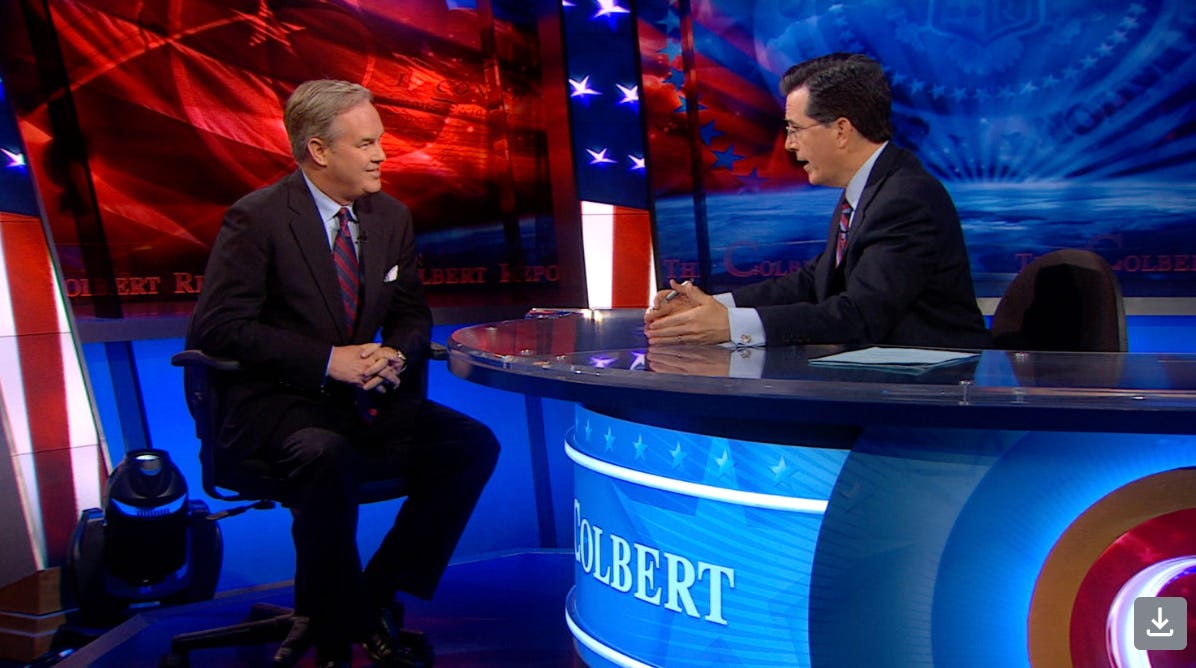
On the line was a staffer from “The Colbert Report,” asking me questions about what a federal PAC was and what rules governed them. Not long afterwards, I found myself sitting across from Colbert himself in front of a studio audience for the first of what would turn out to be eleven episodes aimed at helping his audience understand what was happening to our campaign finance system in the wake of the U.S. Supreme Court’s disastrous Citizens United ruling.
During these episodes, which coincided with the 2012 election cycle, I served as Stephen’s lawyer and “favorite straight man” on set, witnessing his skillful use of comedy to shine a light on the legal loopholes that special interests use to spend secret and unlimited amounts of money to influence our elections. The series earned Stephen the prestigious Peabody Award for journalism. One survey later found that Colbert Report viewers were better educated on the issue of money in politics than those who relied on traditional news programs!
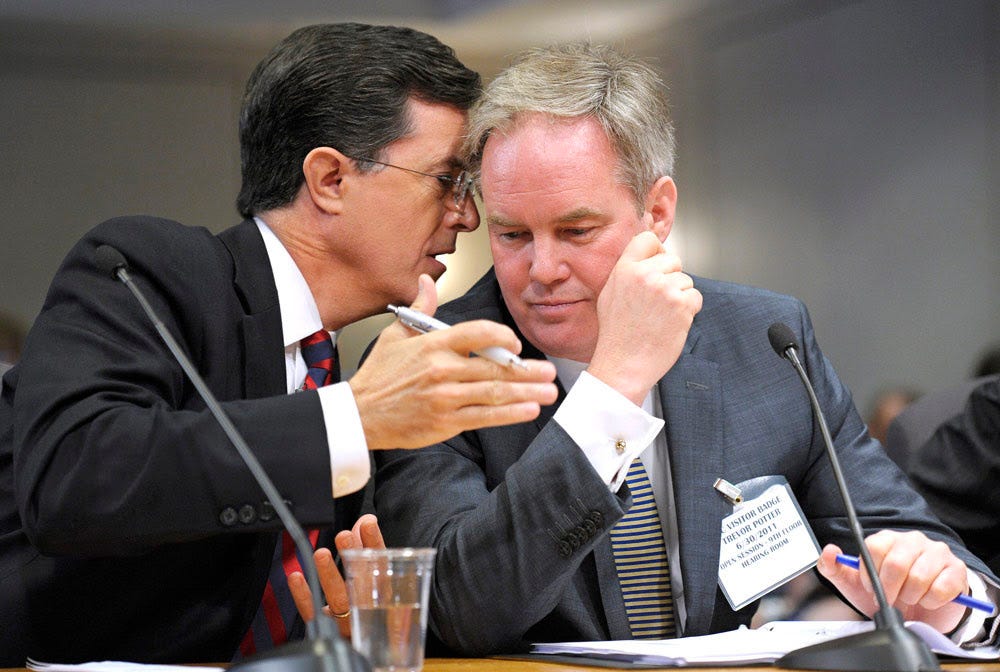
I recently sat down to remember and reflect on this unique experience, which also included the two of us going to the FEC to plead Stephen’s case for official approval of establishing his PAC, “Americans for a Better Tomorrow, Tomorrow.”
Now, the Colbert Report is long gone, and Stephen is preparing to end a very successful run of more than ten years as host of “The Late Show” on CBS. The world moves on — both the good and the bad. The systemic weaknesses in campaign finance law we explored together in satirical fashion 15 years ago are being exploited today at levels never seen before. Consider, for example, that dark money groups spent $1.4 billion dollars during the 2024 election cycle — nearly four times the amount spent during the 2012 cycle. Over time, the proportion of dark money going to super PACs has greatly increased, adding to the lack of transparency and opportunities for corruption that have profoundly changed our political process for the worse.
Furthermore, things at the FEC have also gone from bad to worse since “The Colbert Report” series. In the intervening years, the commission has been mired in gridlock, failing to make any progress on important issues. More recently, a majority of FEC commissioners have voted in favor of campaign finance deregulation and have declined to enforce campaign finance laws at an alarming rate.
One key storyline during the Colbert series was explaining how easy it is for super PACs to get around requirements to operate independently of candidates for political office. In spring 2024, the FEC poured gasoline on this fire of unchecked coordination by wrongly concluding it was legal for candidates and supportive “independent” groups to work together on canvassing activities like door-knocking and voter mobilization.
This “advisory opinion,” as it is known in agency speak, opened the floodgates for an unprecedented level of coordination, with Elon Musk’s super PAC alone spending hundreds of millions of dollars in support of Donald Trump’s campaign. Campaign Legal Center has filed a lawsuit to get the advisory opinion struck down in court, arguing that it was contrary to law and exceeded the agency’s authority.
At its core, the opinion allows super PACs and other supposed “independent” organizations to spend millions effectively underwriting campaign expenses for the candidates they support, with much of that spending going undisclosed.
As I reflect on everything that has happened in our country since my time on “The Colbert Report,” it is impossible to ignore the contributions of the highest court in the land to what can fairly be described as the steady decline of democracy in the United States.
The negative consequences of Citizens United are well known, but the Court may not be finished with its hack job on our campaign finance laws. At CLC, we are anticipating a ruling soon in National Republican Senatorial Committee (NRSC) v. FEC, in which the NRSC has asked the Court to nullify limits in place for the last 50 years, which it previously upheld, on how much money political parties can spend in coordination with federal candidates. Such a ruling would create yet another avenue for wealthy special interests to exert a corrupting influence on our elections.
Then there’s the Roberts-led Court rulings that have destroyed the federal Voting Rights Act, starting with Shelby County v. Holder in 2013 and ending with Louisiana v. Callais on April 29 of this year. These rulings, grounded in the false notion that systemic racism in our elections has been brought to heel, have opened the door for the kind of discrimination in voting laws and practices our country has not seen since the days of Jim Crow.
In 2019, the majority, once again led by Chief Justice Roberts, issued an outrageous opinion that closed the federal courts to those challenging egregious partisan gerrymanders. This ruling, in combination with Callais, threatens the fundamental principle of “one person, one vote,” which holds that all votes should count equally in our representative democracy, because it allows states to hide discrimination behind claims of partisan gerrymandering to avoid court review.
This is to say nothing of several rulings that have made it much more difficult to hold corrupt government officials accountable and a truly shocking 2024 ruling in Trump v. United States holding that the president of the United States is immune from being held to account for illegal activity if he was acting in his “official capacity.”
Campaign Legal Center’s role in this battle for the soul of our democracy is to find pathways to progress through legal actions and policy advocacy. It has been a difficult road. But in the areas of voting rights, redistricting, ethics and even campaign finance, we have achieved significant victories for voters in the face of determined opposition.
Just as important in this struggle, I recognize, are the efforts of those with massive audiences to help Americans understand the forces pushing our nation towards something that bears little resemblance to a representative democracy.
Stephen Colbert is clearly someone who feels called to use his platform to engage in this sort of civic education, reaching Americans who are not immersed in these issues. I wish Stephen all the best in whatever comes next, and hope that he and others in the entertainment industry will keep finding creative ways to ensure Americans remain informed and active in the fight for a more perfect union.
Looking for more in-depth insights on issues critical to our democracy? Consider subscribing to the “From the Desk of Trevor Potter” newsletter, written by Campaign Legal Center’s founder and president, Trevor Potter. Get expert analysis and learn more about Campaign Legal Center’s efforts to protect and strengthen democracy for all Americans by subscribing via email or on LinkedIn.
Well stated Trevor. I’m a lawyer who learned much from your appearances on Colbert. Keep up the good fight.
I don’t know what to say, as you’ve pretty much said it all! Dems will win if we all show up to vote💙💙 Too many stayed home when trump beat HRC.